
B.Sc. Education science in English Language
Program Profile
The College of Basic Education English Department has been offering a range of interconnected progammes that develop procedurally, focusing on the first-hand knowledge expertise in the field of teaching with an emphasis on necessary skills that could equip learners with tangible skills upon graduation ever since its induction as a branch of its counterpart department in Duhok.
Throughout the four-year programme, students are expected to undertake diverse responsibilities – all of which contribute to the preparation of their academic character.
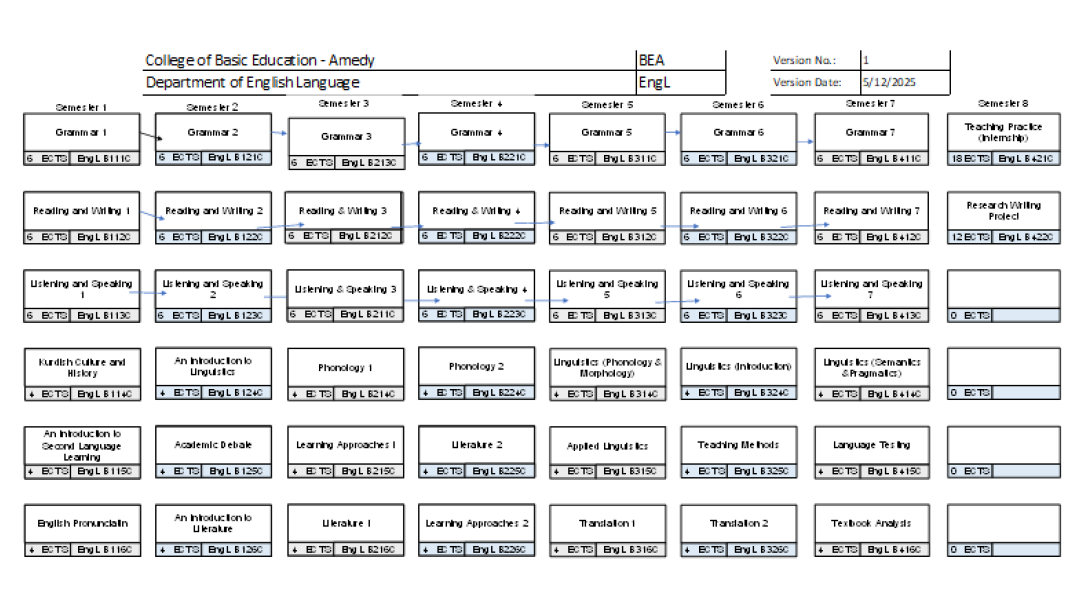
The four-year programme is administered through eight semester following Bologna Process System where students have a wider range of possibilities in terms of flexibilities of continuous learning.
The final semester is wholly dedicated for Internship period where they get an on-job-training as apprenticeships observing and co-teaching at local schools within 30 km far from the college campus. In the same period, they are obliged to work on their graduation papers- a mini-research experience that could prepare their investigative aspirations into relevant issues related to teaching.
Occupational profiles of graduates
Graduates of this programme are equipped with necessary linguistic knowledge which they can both use and expand in promoting their careers.
Typical roles for graduates include:
1. Primary school English teachers
2. Basic school English teachers
3. Private tutors/ course-givers
4. Translators (especially with those exceptionally good ones)
Qualification awarded
Bachelor of Education in English Language Teaching
Length of programme
4 Years
Number of credits
240 ECTS credits
Mode of Study
Full time on campus
Read more about the programme
Get detailed information about the programme requirements, courses, credits, and educational objectives as a PDF file.
Program Educational Objectives (PEOs)
The educational objectives of the college of basic education, English language Department are to prepare graduates who will:
1.demonstrate successful careers in teaching and related disciplines by leveraging linguistic expertise, analytical skills, and innovation to effectively contribute to their professions.
2.exhibit strong leadership, communication and teamwork skills, enabling them to work effectively within multidisciplinary teams.
3.address real-world problems and improve quality of life while upholding ethical standards and considering the broader societal, environmental, and global implications of engineering decisions.
4.engage in lifelong learning through advanced education, professional development, and certifications or other learning opportunities to adapt to evolving technologies, drive innovation, and contribute to the development of new technologies.
5.Undertake pedagogical projects at governmental and non-governmental institutions, tailoring their qualifications for the given teaching demands.
6.Have a deep knowledge in English language to utilize it for educational purposes.
Program Learning Outcomes
After successfully completing this programme, students should have:
1.an ability to identify, formulate, and solve complex engineering problems by applying principles of engineering, science, and mathematics.
2.an ability to apply engineering design to produce solutions that meet specified needs with consideration of public health, safety, and welfare, as well as global, cultural, social, environmental, and economic factors.
3.an ability to communicate effectively with a range of audiences.
4.an ability to recognize ethical and professional responsibilities in engineering situations and make informed judgments, which must consider the impact of engineering solutions in global, economic, environmental, and societal contexts.
5.an ability to function effectively on a team whose members together provide leadership, create a collaborative environment, establish goals, plan tasks, and meet objectives.
6.an ability to develop and conduct appropriate experimentation, analyze and interpret data, and use engineering judgment to draw conclusions.
7.an ability to acquire and apply new knowledge as needed, using appropriate learning strategies.
Programme structure diagram with credits
Yearly Timeline
Sept. 1, 2026
⚠️ First year students start around mid-October
⚠️ First year students start exams around 20 of January
July 1, 2027
Check out the full academic calendar on UoD's webstie.
Programme Coordinator

Applied Linguistics( ELT)
English Language
College of Basic Education – Amedy
University of Duhok
Apply to the Programme
Public undergraduate admissions in the KRG region are managed centrally by the Ministry of Higher Education through the online ZankoLine portal (regayzanko.com). After Grade 12 Baccalaureate results are released, high schools provide students with unique login credentials to rank their preferred universities and B.Sc. majors during a 10–14 day registration window. Final placement is automatically determined by the student's Grade 12 average, subject choices, and department capacity.